Freebuff started selling ads — 500k developers, $500 to get in
- Source: https://freebuff.com/advertisers (sent by owner, 2026-10-03)
- Verdict: keep
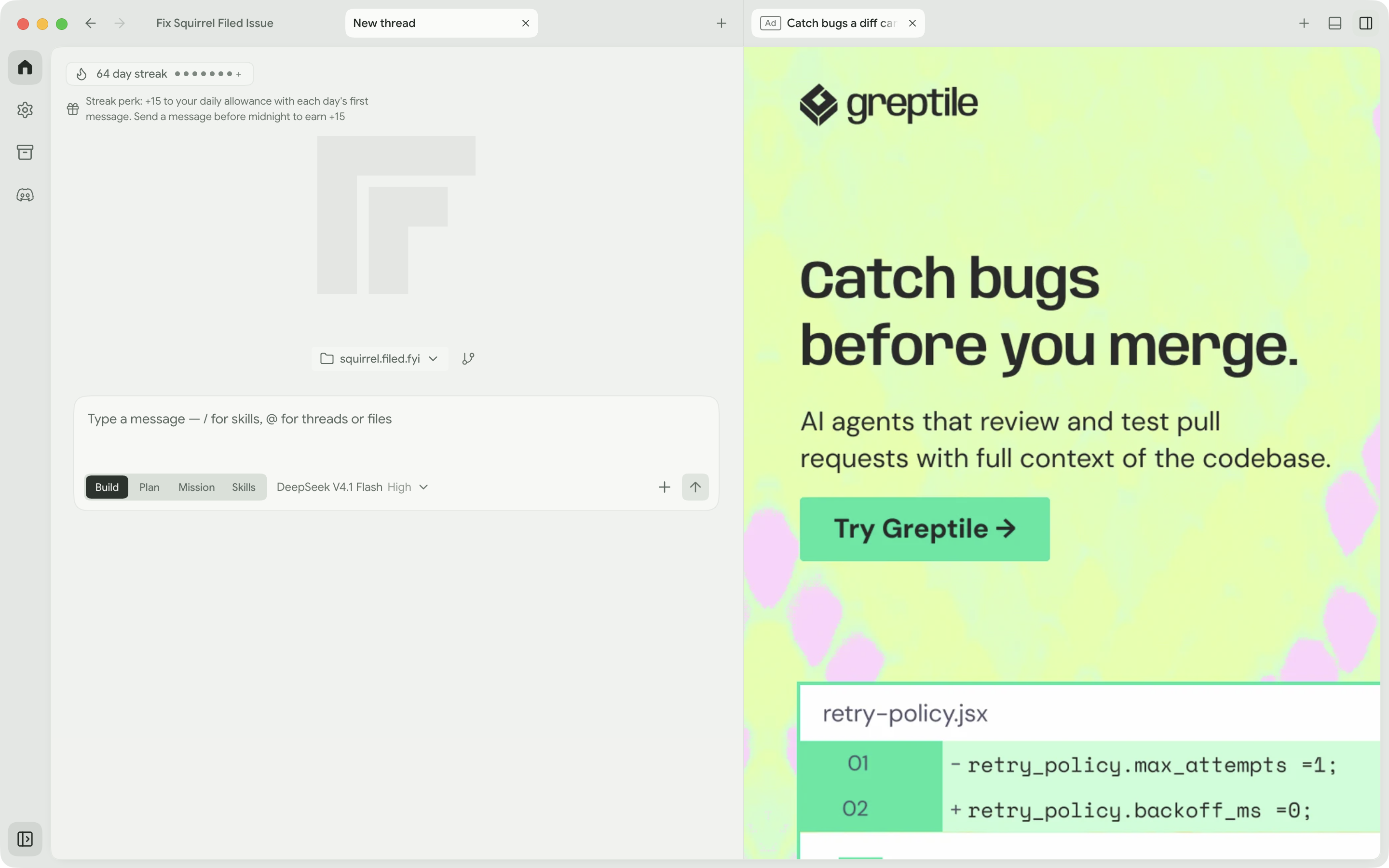
- Why: the ad-funded free coding agent from Freebuff stopped being the buyer's problem and became the seller's business. Two months ago the pitch to users was "text ads between agent turns pay for your models." Now there's an ads console, a rate card, an engagement marketplace, and logos already running inside the app — including the one in the screenshot below. Worth a note because the owner is on this thing daily, and because "free AI funded by ads" just turned into "AI ad network aimed at developers."
What actually launched
Freebuff Ads, live for about a week. The pitch: 500,000 developers, in the CLI, the desktop app, the web chat, and (per the launch post) mobile. Self-serve console, pay-per-click, your own daily and total caps, clicks and conversions in one dashboard. Spend $500 inside your first 30 days and they match it with a $500 credit. Under $10k/month you're on your own in the console; at or above it, you get a human.
Then there's the part that will age interestingly. Alongside display ads they're selling an "engagement campaign": real Freebuff users like, comment on, and repost your X, LinkedIn, Reddit, or GitHub posts, at a flat $0.50 per engagement, "verified before it counts," against a daily budget you set. That is not an ad unit. That is a paid-engagement marketplace with an ad unit's paperwork, sold to people who want developer attention and don't want to call it astroturfing.
The tenants already moved in
The advertisers page names three: Greptile, ARCHIL, ObsessionDB. Greptile is the one in the ad rail above — "Catch bugs before you merge," an AI pull-request reviewer, advertised inside a free AI coding agent. Which is a genuinely funny stack: you run the free agent to write the code, and the paid agent across the aisle offers to catch what the free one missed. A competitor-adjacent product sold straight to the audience of the free tier. Nobody is pretending otherwise, and that's the whole point.
What the screenshot shows
This is Freebuff Desktop mid-session. The old format — a line of text
between agent turns — is gone. The ad is now a full-height panel beside
your editor: logo, headline, body copy, a CTA button, and a little
decorative diff (retry_policy.max_attempts =1 → backoff_ms =0) to
make it look like a tool. It sits there while the agent works, not just
between turns. The model picker reads DeepSeek V4.1 Flash at High; the
streak badge says 64 days, which tells you the owner did not download
this last week to look at an ad.
The deal, re-read with the bigger slot
February's launch post promised "small, text-only ads from sponsors developers actually use… between agent turns, not inside generated code or as popups." Text-only between turns is now a display panel on four surfaces plus a paid-engagement product. The privacy language, though, hasn't moved: prompts, messages, agent traces, code, and files are used to run Freebuff and "may be analyzed to personalize ads"; separately uploaded files and connected repositories are not handed to advertisers; restricted partners may evaluate connected Cloud repos but not otherwise use, share, or train on them. Same bargain as August, same warning: fine for hobby repos, think hard before pointing it at anything that pays the rent. What changed is only how big the ad next to your code gets.
The repos, checked
CodebuffAI is a six-repo org and it's still shipping — freebuff was
updated the same day this was filed. The shape of it:
| repo | what it is |
|---|---|
| freebuff | the products; Apache-2.0 TypeScript monorepo, 13.1k stars, ~1.4k forks |
| codebuff-community | showcase of things people built with it |
| evalbuff | internal evals, TypeScript |
| opentui | fork of anomalyco/opentui |
| stagehand | fork of browserbase/stagehand, for browser-use |
| codebuff-swe-bench | fork of Aider's SWE-bench harness |
The "open multi-agent framework" claim holds up better than most: the products are actually in the repo, and the three forks are honest about being forks — the TUI, the browser automation, and the benchmark rig are all borrowed wholesale. Stars went 10.8k → 13.1k since the August entry, so either the ads are working or the model catalog is. Both, probably.
The catalog itself has turned over. MiMo 2.6 Flash is the default now; GLM 5.3 Flash took over the deep-reasoning slot from the retired DeepSeek V4 Pro; DeepSeek V4.1 Flash is the unmetered fast-coding pick (and the one in the screenshot). GPT-6 Luna, Solar Mini 4 and Solar Pro 4 (524K context), and Space Bunny Alpha — a stealth model from an anonymous provider that "retains prompts," stated plainly in the README as if that's a feature. Gemini 3.8 Flash and Muse Spark 1.3 sit behind paid plans; GPT-6.1 Sol is a US-only promo slot. Billing is now Freebucks: every model costs Freebucks at the price in the picker, the free limited-access allowance is 25 a day (20 behind a VPN), and referrals and bounties top up the wallet.
Why it gets filed
The interesting thing isn't that a free product shows ads. It's that the developer-tool category found the ad format and started selling it on purpose — same audience, same surfaces, same "verified engagement" line the influencer economy already burned through. Freebuff is a clean test case because the owner is a real daily user, so there's usage evidence in bulk when someone finally writes the review. The ad platform is the news; the review is still waiting on the owner.
relations
children
backlinks